
Getting the machine to its place.
Between the loading dock and the final plinth lies what is often the tightest passage of the whole project.
Data center equipment logistics and lifting covers the transport, handling and positioning of heavy or oversized equipment: transformers, high-rating switchboards, chillers, standby generators. It is a short phase with little tolerance for improvisation: access, floor loading and clearance constraints are poorly discovered on delivery day.
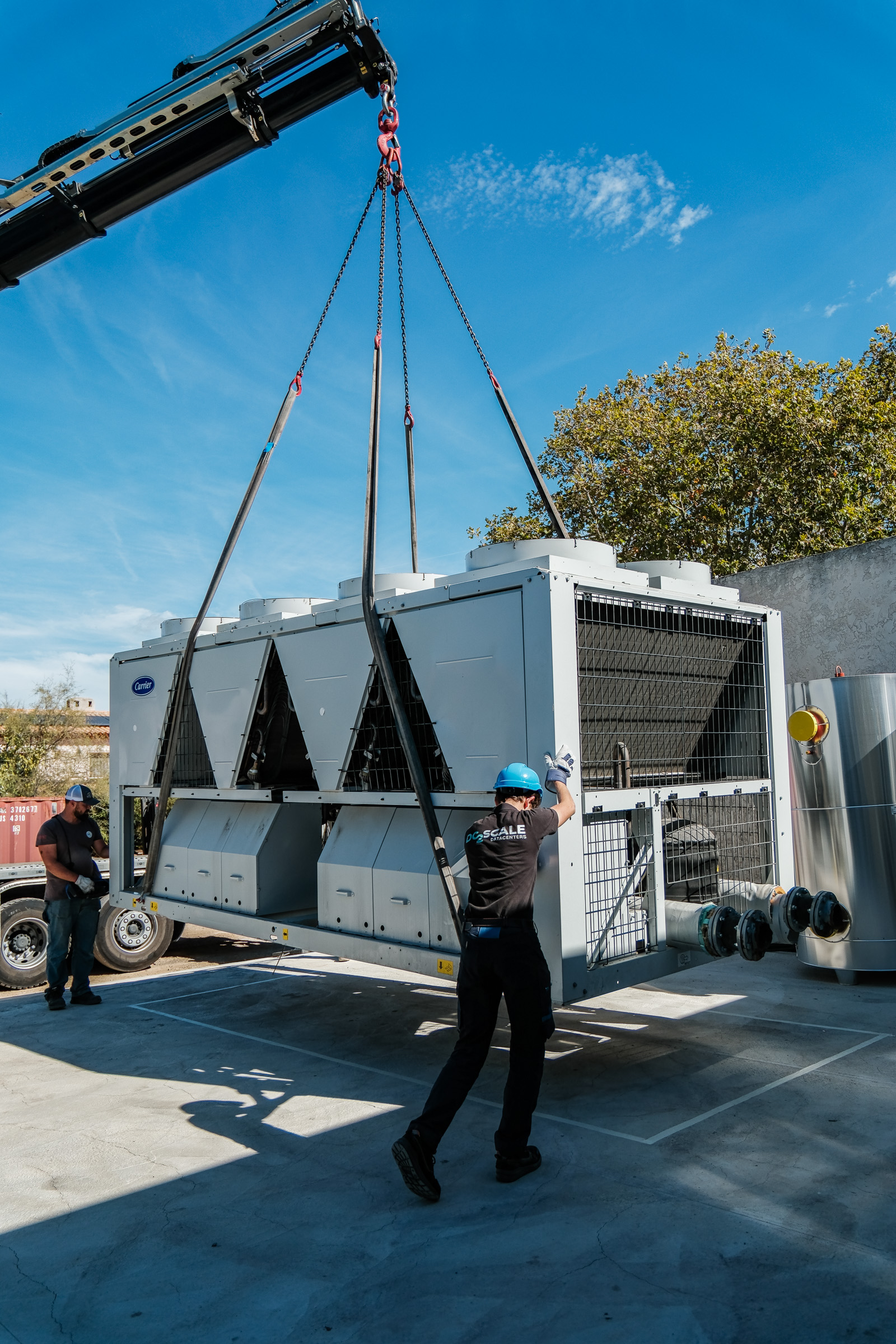
The route, to be studied before purchase
Equipment is selected on its performance and delivered through a door. The usual chronology of projects means the second question arrives after the first, sometimes too late: the machine is ordered when someone discovers it will not pass the airlock, that the intermediate slab will not take its rolling load, or that the only crane path passes over a room in service.
We therefore study the access route at the same time as the equipment selection: successive clearances, headroom, permissible floor loading, crane capacity, road and timing constraints. It is an inexpensive study whose absence gets paid for in building alterations.
Handling alongside a critical load
On a live site, a lift is not only a matter of capacity: it is a matter of consequence. A path over a room in service, vibration transmitted through the structure, a blocked fire access route - any one of these can rule out a method that is otherwise technically sound.
We treat these operations as high-risk work: written method, approved paths, negotiated slots, and for every phase the question of what happens if it has to stop midway. That is what allows them to proceed without putting operations at risk.
Where this expertise applies
The data center packages this expertise covers are shown in full, the others are dimmed. Click a package for detail.
Medium-voltage switchgear distributes and protects; transformers step the voltage down to usable low voltage. These are very long-life assets, where reuse saves several quarters of lead time.
The last line of backup, with its fuel tanks and bunding. A generator only counts once its load acceptance has been tested for real, several times - untested redundancy is a hypothesis.
Chillers and free cooling, producing the chilled water. In the French climate a large share of the year can be covered without compression - provided the loop accepts warm enough water.
Scope
From the access study through to final positioning on the plinth.
- Access and route study
- Clearances, headroom, permissible loading, crane paths, road and timing constraints.
- Transport
- Road transport of equipment, including abnormal loads and oversized items.
- Lifting
- Craning and lifting, including constrained paths and operations over sensitive areas.
- In-building handling
- Internal movement, passing airlocks and doorways, level changes, protection of floors and finishes.
- Positioning and levelling
- Placement on the plinth, packing, levelling, fixings and anti-vibration mounts.
- Buffer storage
- Interim storage where the site is not ready to receive delivered equipment.
How an operation runs
Four stages, the first of which governs all the others.
Access study
Survey of the complete route, from delivery point to plinth. Conclusions issued before the equipment is ordered wherever that is still possible.
Method and permits
Written method statement, lift plans, road permits, work slots and operational approvals.
Execution
Transport, lifting and handling within the agreed slots, with protection measures in place.
Positioning
Placement, packing and levelling, then handover to the team responsible for connections.
Frequently asked questions
When should we involve you on this?
Before ordering heavy equipment, ideally. It is the only point at which an access constraint can still steer the choice of equipment rather than force an alteration to the building. An access study costs a fraction of widening an airlock or strengthening a slab.
Do you work on sites in operation?
Yes, that is the most common case. These operations are run with a written method statement, approved paths, slots negotiated with operations, and a prepared response for every phase that might have to stop.
Do you handle abnormal loads?
Yes, transport and permits included. Power transformers and high-capacity chillers frequently fall into that category, and permit lead times must be built into the programme well in advance.
Who are you, exactly?
Three very different people land on these pages. Take the door that fits you.
- You areA data center operator or builderYou have works to get done, on a greenfield site or one in service: electrical, cooling, retrofit, decommissioning.Talk about works
- You areLooking for capacity in FranceAI operator, hyperscaler or enterprise: you need megawatts, a convertible site and a contractor able to deliver them. We are a contractor on 240 MW at Béthune.Talk capacity and sites
- You areThe owner of land or a buildingAn industrial brownfield, a warehouse, a dormant grid connection: we tell you what your site can host, before you commit spend.Have a site qualified