
Power, from the HV intake to the rack.
The whole chain, from the high-voltage intake to the rack feed - on installations that are not allowed to stop.
Data center electrical works cover the complete power chain feeding a computing load: high-voltage intake, medium-voltage switchgear and transformers, main low-voltage switchboards, uninterruptible power supplies and standby generators. What sets them apart is less the equipment than the continuity requirement: every device must be able to fail without the load noticing, which calls for genuinely separated redundancy and transfers proven by testing.
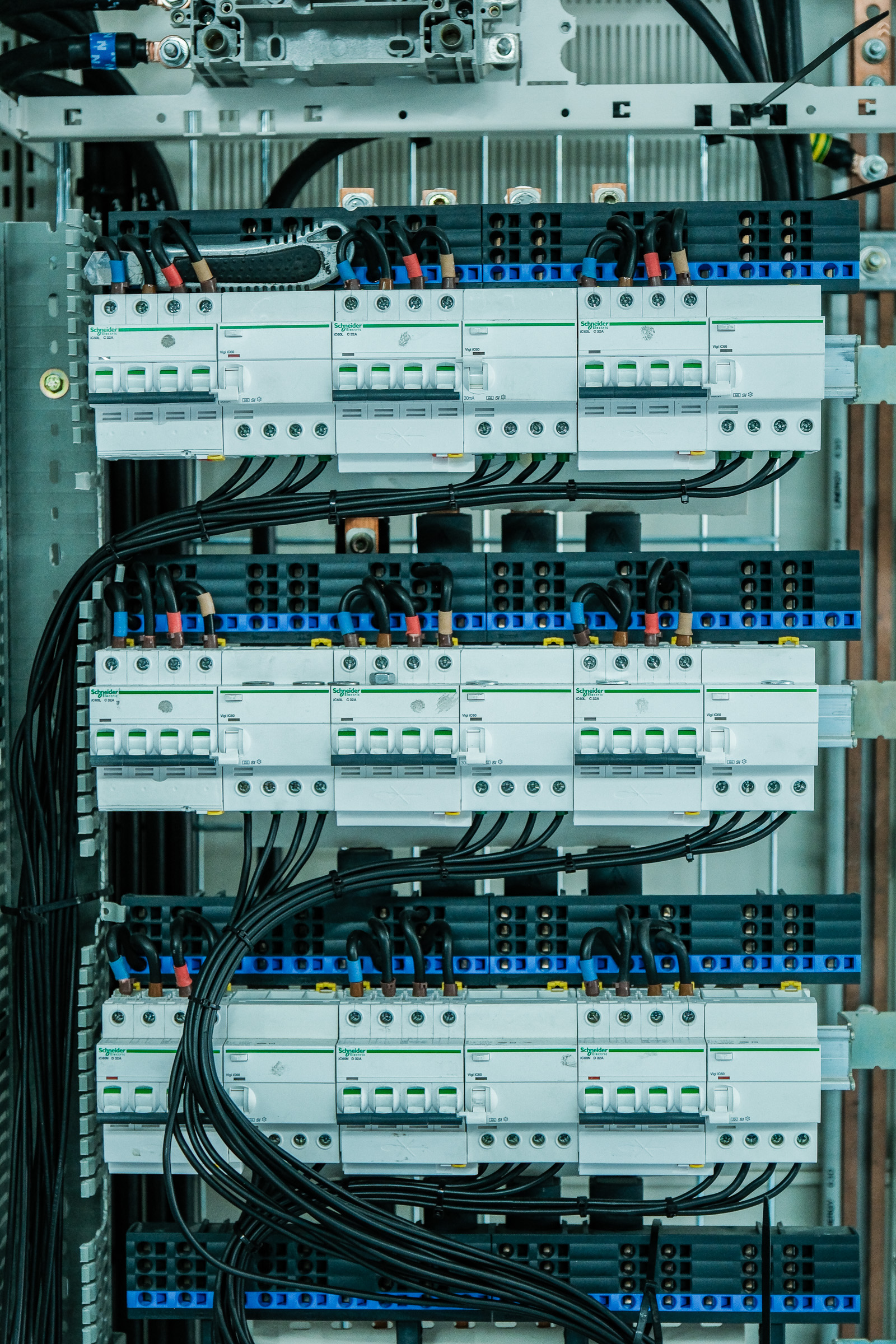
A chain where no link may fail alone
A data center is judged on its ability to absorb a fault without service interruption. That property does not come from the quality of individual devices - commercially available equipment is reliable - but from the architecture connecting them. Two power paths sharing a cable route, a room or a switching device are not two paths: they are one path with twice the equipment.
That is why our work starts by reading the architecture rather than the schematics. Where are the convergence points? Which rooms hold both paths? Does the backup supply have its own route? These questions determine the resilience actually achieved far more than the brand of switchboard.
The second point is testing. Untested redundancy is a hypothesis. We consider that a transfer exists only once it has been performed under load, several times, with the measurements to document it.
Working without cutting the load
Most of our work takes place on sites already in service. That changes its nature: it is no longer only about installing compliant works, but about inserting them into a live installation without ever putting the load at risk.
In practice that means isolations requested and granted properly, transitional operating modes written and approved before work starts, night or weekend windows, and for every sensitive operation a fallback plan defined in advance. It is a discipline of preparation more than a feat of execution.
Where this expertise applies
The data center packages this expertise covers are shown in full, the others are dimmed. Click a package for detail.
Where energy enters the site, at the interface with the public grid. It caps the available capacity: on a retrofit, what it can carry decides what the building can host.
Medium-voltage switchgear distributes and protects; transformers step the voltage down to usable low voltage. These are very long-life assets, where reuse saves several quarters of lead time.
The main low-voltage switchboard distributes power to the halls and the utilities. This is where discrimination is decided: a fault must be cleared as close as possible without tripping anything upstream.
The uninterruptible supply holds the load until the backup starts. We requalify UPS units but always replace batteries with new: their ageing cannot be recovered.
The last line of backup, with its fuel tanks and bunding. A generator only counts once its load acceptance has been tested for real, several times - untested redundancy is a hypothesis.
Technical scope
We work across the whole chain, either as principal electrical contractor or as a separate package.
- High-voltage intake substation
- Requalification or new build, interface with the network operator, metering and decoupling protection.
- Medium-voltage switchgear
- Supply and installation of switchgear, protection, discrimination, dielectric testing and energisation.
- Transformers
- New or refurbished power transformers, including handling, positioning and connection.
- Main LV switchboards
- Main switchboards up to high ratings, busbars, outgoing ways, earthing arrangements and upstream-downstream discrimination.
- Uninterruptible power supplies
- UPS units and battery banks, bypass arrangements, autonomy sizing and discharge testing.
- Standby generators
- Standby generating sets, fuel tanks and bunding, source changeover, start-up and load acceptance testing.
- Final distribution
- Cable containment, room-level boards, rack power distribution units and complete labelling.
How an engagement runs
On a live site, half the work happens before anyone touches anything.
Survey of the existing installation
Actual condition of the works, protection settings and cable routes, checked against available drawings - which are rarely current.
Design and calculations
Load balances, short-circuit currents, discrimination, voltage drops. Produced by our own design office.
Risk analysis and transitional modes
For every operation touching the load: required isolations, transitional operating mode, fallback plan.
Procurement
New or refurbished, depending on lead time and criticality. On transformers and switchgear, reuse often saves months.
Installation and connection
Execution within the agreed windows, under the isolations in force, with labelling kept current as work proceeds.
Testing and documentation
Level-by-level testing through to transfers under load, test certificates, updated schematics and as-built file.
Frequently asked questions
Do you work on live electrical installations?
We work on live sites, but the rule is to isolate whatever we work on. Operations that cannot be isolated are subject to a specific risk analysis, a written method statement and appropriate authorisations. The principle stands that operative safety is not traded against an operational window.
Which voltage levels do you cover?
From the high-voltage intake to the rack feed: incoming substation, medium-voltage switchgear and transformers, then all low-voltage distribution through to rack power distribution units. Covering the whole chain means there is no interface to arbitrate between several contractors precisely where responsibilities are most blurred.
Is a refurbished transformer reliable?
A transformer is a passive, robust asset whose useful life far exceeds that of the active equipment around it. Properly refurbished - dielectric testing, oil analysis where applicable, documented requalification - it offers reliability comparable to new. Its real advantage is lead time: where new units take several quarters, a refurbished one can be available in weeks.
How do you guarantee protection discrimination?
By calculation before the work, and by testing after it. Our design office produces the short-circuit calculations and the upstream-downstream discrimination study, settings included. Those settings are then verified at commissioning and the certificates added to the as-built file.
Who are you, exactly?
Three very different people land on these pages. Take the door that fits you.
- You areA data center operator or builderYou have works to get done, on a greenfield site or one in service: electrical, cooling, retrofit, decommissioning.Talk about works
- You areLooking for capacity in FranceAI operator, hyperscaler or enterprise: you need megawatts, a convertible site and a contractor able to deliver them. We are a contractor on 240 MW at Béthune.Talk capacity and sites
- You areThe owner of land or a buildingAn industrial brownfield, a warehouse, a dormant grid connection: we tell you what your site can host, before you commit spend.Have a site qualified