
Removing heat, at AI scale.
Rack densities have changed by an order of magnitude. Cooling infrastructure built for conventional IT no longer keeps up.
Data center cooling continuously removes the heat produced by computing equipment while holding temperature and humidity within acceptable ranges. It combines a cooling plant, a distribution network and in-room delivery. Artificial intelligence workloads have moved the problem: at densities of several tens of kilowatts per rack, air alone is no longer sufficient and direct liquid cooling becomes the reference.
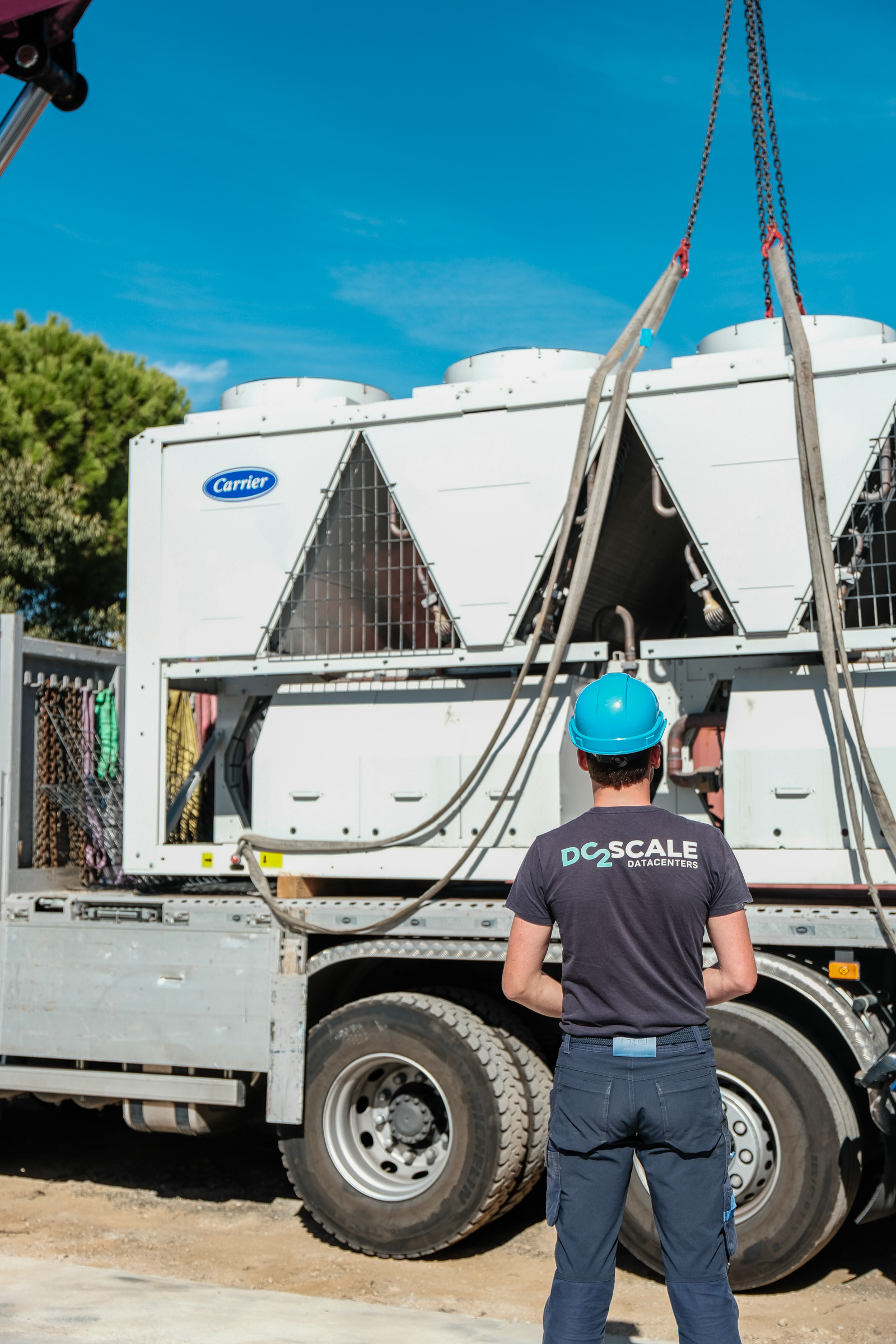
A change of scale, not an evolution
For twenty years, cooling a data center meant blowing cold air under a raised floor for racks drawing a few kilowatts. Today's training and inference workloads dissipate per rack what an entire row once did. At those densities the heat capacity of air becomes the limiting factor: the required airflows exceed what ductwork and acoustic comfort allow.
Direct liquid cooling answers that physical wall by bringing fluid into contact with the components. It changes the nature of the infrastructure: no longer only air handling units, but hydraulic loops, in-room distribution, water quality and leak-tightness above live electronics.
For an existing site, the practical consequence is that an AI-oriented retrofit is first a hydraulic project. It is also what makes anticipation pay: making a building liquid-ready before the need arises costs a fraction of the same work carried out later, in operation.
Free cooling, where the climate allows
In the French climate, outdoor temperatures allow cooling without compression for a large part of the year. Exploiting that resource - by direct outdoor air exchange, by coil on a water loop, or adiabatically - cuts consumption by margins few other measures reach.
The trade-off is not only about energy. Free cooling requires roof or façade area, admits a degree of humidity that must be controlled, and calls for controls that handle mode transitions cleanly. We assess this choice on site data - the actual weather file for the location and the expected load profile - rather than on national averages.
Where this expertise applies
The data center packages this expertise covers are shown in full, the others are dimmed. Click a package for detail.
Chillers and free cooling, producing the chilled water. In the French climate a large share of the year can be covered without compression - provided the loop accepts warm enough water.
The networks carrying cooling to the halls, and the units that deliver it. This is the package most deeply transformed by the arrival of direct liquid cooling.
The usable space: rack layout, aisle containment, cable routes and raised floors. At AI densities, room geometry matters as much as installed cooling capacity.
Technical scope
From plant to containment, in design as well as installation.
- Cooling plant
- Air- or water-cooled chillers, new or refurbished, including handling and positioning.
- Free and adiabatic cooling
- Sizing on site weather data, heat exchangers, towers, and control of transitions between modes.
- Hydraulic networks
- Primary and secondary circuits, pumps, valves, balancing, water treatment and quality, insulation.
- Direct liquid cooling
- Technical loops, coolant distribution units, rack connection, and building infrastructure ready to accept DLC.
- In-room delivery
- Computer room air handlers, air handling units, ductwork and air distribution.
- Containment
- Hot or cold aisle containment, blanking, floor and cable penetration sealing.
- Controls and supervision
- Local controls, reporting to the building management system, measurement points, alarms and efficiency monitoring.
How a cooling engagement runs
Thermal design rests on site data: that is what separates sizing from estimating.
Load profile and site data
Current and target load, rack densities, local weather file, roof and footprint constraints.
Cooling scenarios
Costed comparison of the viable architectures, with their consequences for consumption, footprint and headroom for higher density.
Design and simulation
Thermal balances, hydraulic sizing and, on sensitive points, airflow simulation of the rooms.
Procurement
New or refurbished. On high-capacity chillers, reuse shortens lead time appreciably.
Installation
Positioning, hydraulic and electrical connection, insulation, pressure testing and flushing.
Balancing and commissioning
Network balancing, control tuning, load testing and verification of transitions between modes.
Frequently asked questions
At what density does liquid cooling become necessary?
Air remains workable up to around ten kilowatts per rack with good containment, and can be pushed beyond at the cost of rising airflow and noise. Current AI training workloads far exceed those figures, which makes direct liquid cooling unavoidable. The real threshold depends as much on room geometry as on the stated density: it is a matter for simulation, not a general rule.
Can an existing data center be made liquid-cooling ready?
Yes, and it is a growing part of our work. It requires bringing a hydraulic loop to the rooms, verifying that the structure accepts the water loads, and treating leak detection above live electronics seriously. Carrying out that work before it is needed costs considerably less than doing it later, in operation.
Is free cooling worthwhile everywhere in France?
It delivers a gain across the country, but its size varies markedly with the local climate and with the water temperature the installation accepts. The warmer the water the loop tolerates, the more operating hours become available - that parameter matters more than latitude. We assess the trade-off on the site weather file.
Does a refurbished chiller hold its performance?
Provided it is properly requalified: refrigerant circuit inspection, leak-tightness, replacement of wearing parts, documented performance testing. We only return machines to service whose efficiency has been measured, not merely found to run. The decisive advantage remains lead time on high capacities.
Who are you, exactly?
Three very different people land on these pages. Take the door that fits you.
- You areA data center operator or builderYou have works to get done, on a greenfield site or one in service: electrical, cooling, retrofit, decommissioning.Talk about works
- You areLooking for capacity in FranceAI operator, hyperscaler or enterprise: you need megawatts, a convertible site and a contractor able to deliver them. We are a contractor on 240 MW at Béthune.Talk capacity and sites
- You areThe owner of land or a buildingAn industrial brownfield, a warehouse, a dormant grid connection: we tell you what your site can host, before you commit spend.Have a site qualified